Areia Preta Beach in Guarapari: the sand behind the fame
What monazite sand is, where the Cidade Saúde nickname came from, what science has measured on the beach and how to fit a visit into a walk through downtown.
10/31/2026
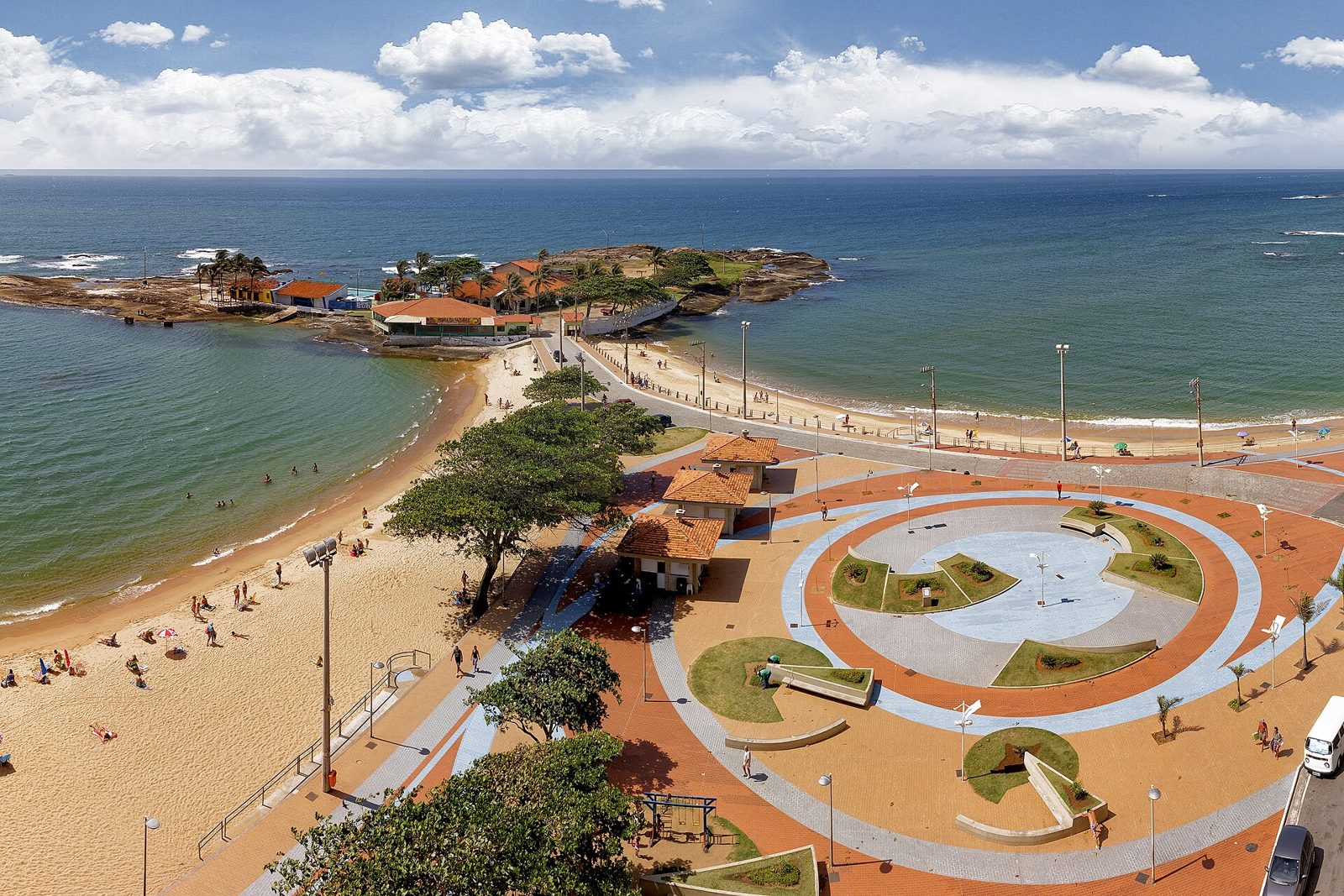
Areia Preta Beach is a small urban beach in downtown Guarapari, and the dark color that gives it its name comes from heavy minerals mixed into the light sand, among them monazite, which contains thorium and emits natural radiation. It was this sand that, from the 1930s onward, helped turn a port town into a health tourism destination and earned Guarapari the nickname Cidade Saúde, the "Health City". Today the visit is short, free of charge and pairs well with the neighboring beaches and the Historic Center, about 15 minutes by car from the cabins.
What is the monazite sand of Areia Preta?
The dark patches that appear over the golden sand are concentrations of heavy minerals: ilmenite, zircon, garnet and monazite. Monazite is a phosphate rich in rare earth elements and thorium, an element that naturally emits gamma radiation. Because they are denser, these grains separate from ordinary sand with the ebb and flow of the waves and form bands and patches that shift with the tide and the season. That is why the beach never looks exactly the same: on some days the dark band is wide and continuous, on others it appears only in patches near the rocks and the waterline.
Where did the Cidade Saúde nickname come from?
The mineral wealth drew attention before tourism did. The sands of Guarapari were identified in 1898 and, from 1906 onward, were processed on an industrial scale by foreign-owned companies and, later, by Mibra, Monazita e Ilmenita do Brasil, which mined and exported the ore. The operation was later transferred to Nuclemon, a subsidiary of the state-owned Nuclebrás, and only ended in 1986, after a campaign by the city government to stop extraction on the municipality's beaches.
At the same time, physician Antônio da Silva Mello, who had researched the effects of radioactivity at the Radium Institute in Berlin, began writing about the sands of Guarapari in the 1930s, in nationally circulated magazines such as O Cruzeiro. The articles credited the sand with an effect on joint and rheumatic pain, and the town stopped being seen merely as a port and became a destination for summer holidays and treatment. In the 1960s and 1970s, the resort drew tourists seeking relief from rheumatism and arthritis, and even today it is common to see beachgoers with their bodies covered in the dark sand, out of tradition. The Radium Hotel, opened in December 1953 facing the beach, carried the idea even in its name. The story of the hotel and the surrounding historic buildings is in the guide to the Historic Center of Guarapari.
The same dark sands that supplied mining companies for eight decades filled the hotels with summer visitors.
Is the black sand dangerous or good for health?
The radiation is real and measured. Studies record doses between 10 and 30 microsieverts per hour over the sands of Guarapari, with isolated spots of higher concentration and higher values in summer than in winter. These levels are well above the average natural background, and the dose received depends on the length of exposure. A study published in 2024 in the World Journal of Nuclear Medicine compared health indicators in Guarapari with those of Campos, Rio Grande and Ilhéus and found no increase in cancer mortality, childhood tumors or congenital malformations in the city; according to the authors, none of the indicators assessed showed a statistically significant difference.
On the other hand, there is no scientific evidence of any therapeutic effect. The reputation for healing belongs to the history of local tourism, not to medicine, and the tradition of covering oneself with the dark sand should be read that way: as a custom, not as a treatment. In practice, the most common plan for visitors is to walk along the dark band to see the minerals up close and lay a beach wrap wherever is most comfortable, without forgetting sunscreen and a hat during the hours of strong sun.
How to visit Areia Preta from the cabins?
- Leave in the morning: downtown is about 8 km from the cabins, some 15 minutes by car, and traffic gets heavier after lunch on holidays and weekends.
- Park before entering the narrower downtown streets and continue on foot along the waterfront; in high season, parking spots near the beaches are hard to find, and the central beaches sit right next to one another.
- Walk along the dark band next to the rocks, where the concentration of minerals is usually most visible, and check the water quality bulletin before going in; with children, take extra care near Pedra da Siribeira, where the sea is not shallow.
- Continue on foot to Praia do Meio and Praia das Castanheiras; at low tide, the reef between the two forms shallow natural pools with small fish, sea urchins and starfish, so it is worth checking the tide table the day before and wearing shoes suited to rocks.
- End the outing at Parque da Areia Preta, home to the [Municipal Fish Market](/diario/mercado-peixe-guarapari-perocao), to take lunch or dinner back to the cabin.
What else is there to do on the same outing?
Areia Preta works better as a stop on an itinerary than as a beach for the whole day: it is small, surrounded by the city and very crowded in high season. Within the same walking radius are Praia do Meio and Praia das Castanheiras, the seaside square, the Radium Hotel, the Igreja Matriz and the ruins that tell the story of the city's Jesuit origins.
In front of the Radium's façade, its history is worth recalling: the building was begun in 1947 to house a naval school, opened in December 1953 as a luxury hotel-casino with 140 rooms, and closed its doors for the first time in 1964. Since 1998 it has been protected by the State as historic heritage of Espírito Santo. In two or three hours it is possible to see the sand that made Guarapari famous, understand why it attracted mining companies and physicians, and return to the cabins in time for a calmer afternoon on the neighborhood beach.
A quiet base 15 minutes from downtown Guarapari
The Cavalo Marinho and Ouriço do Mar cabins are in the northern part of Guarapari, close enough to downtown for a morning outing and far enough from the bustle to rest afterward. Direct booking with personal service.
See the cabins and check datesFrequently asked questions
Why is the sand at Areia Preta Beach dark?
The color comes from heavy minerals mixed into the light sand, such as monazite, ilmenite, zircon and garnet. Because they are denser, they separate with the movement of the waves and form dark bands and patches, which shift with the tide and the season.
Is the monazite sand of Guarapari radioactive?
Yes. Monazite contains thorium, which emits natural gamma radiation, and measurements record between 10 and 30 microsieverts per hour over the sand. A study published in 2024 found no increase in cancer, childhood tumors or malformations in Guarapari compared with other Brazilian cities.
Does the black sand treat rheumatism or other diseases?
There is no scientific evidence of a therapeutic effect. The reputation came from the articles by physician Antônio da Silva Mello, published from the 1930s onward, and from the health tourism of the following decades. Covering the body with the sand is a local custom, not a medical recommendation.
Why is Guarapari called Cidade Saúde?
The nickname arose from Silva Mello's articles on the monazite sands, which from the 1930s onward attracted visitors seeking relief from joint pain. The reputation changed the profile of the town, which stopped being seen merely as a port and became a summer holiday destination, and the name stuck even without scientific backing.
How long does it take to get from the cabins to Areia Preta Beach?
About 15 minutes by car, on a route of roughly 8 km to downtown Guarapari. On summer holidays and weekends, it is worth leaving in the morning and parking before the narrower downtown streets, then continuing on foot along the waterfront to the neighboring beaches.
Sources
- https://pmc.ncbi.nlm.nih.gov/articles/PMC11828634/
- https://www.researchgate.net/publication/258816426_Modelling_Natural_Radioactivity_in_Sand_Beaches_of_Guarapari_Espirito_Santo_State_Brazil
- https://www.osti.gov/etdeweb/biblio/21217483
- https://www.morrodomoreno.com.br/materias/guarapari-cidade-saude.html
- https://morrodomoreno.com.br/materias/areia-monazitica-de-guarapari-fim-da-exploracao.html
- https://www.agazeta.com.br/es/cotidiano/a-guerra-nuclear-guarapari-praias-bombas-e-exploracao-litoral-brasileiro-0921
- https://tribunanorteleste.com.br/terras-raras-o-escandaloso-roubo-de-areia-monazitica-de-guarapari-pelos-eua/
- http://www.al.es.gov.br/Noticia/2019/04/36609/areia-monazitica-e-tema-da-comissao-de-turismo.html
- https://pt.wikipedia.org/wiki/Praia_da_Areia_Preta
- https://capixabadagema.com.br/praia-da-areia-preta-em-guarapari/
- https://www.guaraparivirtual.com.br/312/praias-do-centro-guarapari
- https://www.portal27.com.br/pontos-turisticos-de-guarapari/
- https://www.agazeta.com.br/capixapedia/radium-conheca-o-hotel-cassino-do-es-famoso-por-atrair-celebridades-0822
- https://www.guarapari.es.gov.br/pagina/ler/2182/praia-da-areia-preta